within-group variance
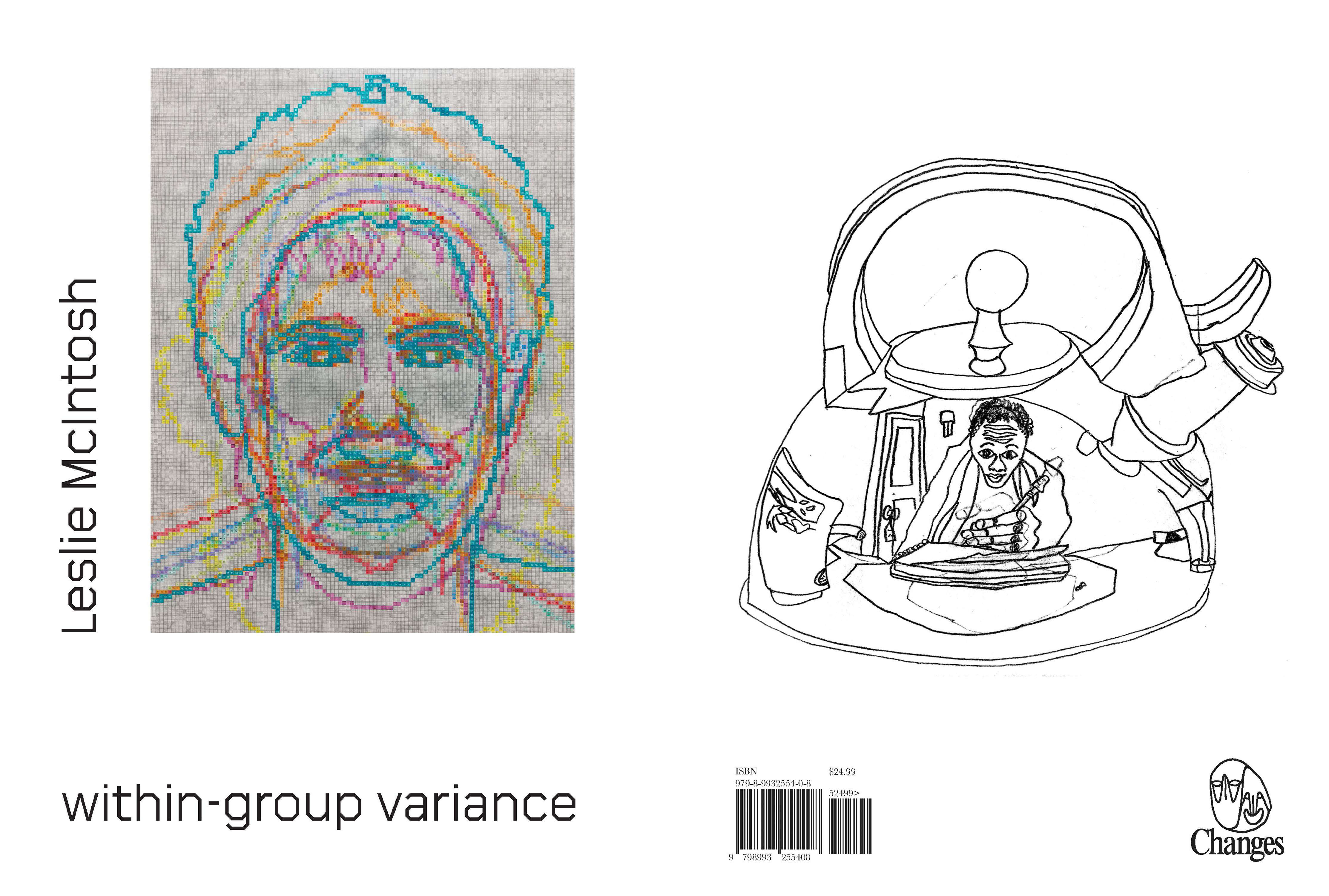

within-group variance
By Leslie McIntosh
Publication date: September 1, 2026
ISBN: 979-8-9932554-0-8
6.5x9, 102 pp., paperback
$24.99
Leslie McIntosh’s brilliant debut within-group variance pushes beyond the limitations of identity politics in pursuit of a “me that is me everywhere.” Through archival fabulation, data theory, diagrams, redactions, and epistles, McIntosh weaves a kaleidoscopic lyric that probes the terrains of Black identity and history, invoking a multidisciplinary network of muses along the way, including Bayard Rustin, Phillis Wheatley Peters, and Charles Gaines. With tenderness and rigor, these poems insist on the multiplicity of the self and the possibilities of language to hold it.
The poet Jay Wright says, “Every individual is as complex as my poetry. I will honor that gift.” Leslie McIntosh crafts literary art embracing this edict. At vertiginous angles of sensorial, intellectual, and spiritual intersection, Leslie’s work engages the far-reaches of human consciousness, identity, and their respective futures. Leslie has presented these inquiries across the country as a featured guest at universities, literary festivals, national poetry slams, and other convenings since 2005, but currently calls home a rowhouse on the stolen land of the Munsee Lenape, presently known as Jersey City, NJ, USA.



Praise for within-group variance
“Shapeshifting promiscuously, spellbinding, within-group variance, a collection as feral as it is cerebral, taps into your own ravenous imagination. Don’t mind when the music gets stuck in your teeth. Leslie McIntosh, the ‘devious trickster’ responsible for these poems, spins filaments of ‘harpsichords &… drawers on the floor.’ This debut braids hero, historian, and mystic to pioneer an American lyric that orchestrates multitudes while celebrating the self.”
–Gregory Pardlo, author of Digest, winner of the 2015 Pulitzer Prize in Poetry
“In a violent society convinced that its harmful impositions, its force and forced narratives take precedence over human sovereignty and self-possession, Leslie McIntosh’s within-group variance says no. Via theory, memory, diagrams, analogies, redactions, inequal equations, and especially, in letters from and to Bayard Rustin, this collection refuses to hide the internal and external costs of battling destructive systems that insist they’re designed to serve. ‘I thought my thoughts would save me,’ he writes. Instead, we must learn to ‘trust the dark’: an attention turned inward, and to the past—between the history we’re taught, and the truer history written in our cells and souls. In a sprawling verse examination of writer-ancestor Phillis Wheatley, McIntosh brings the fact that we don’t know her real name to bear on the very concept of our beginnings in this country as Black people, as Black writers, elucidating the danger of not just what we call ourselves but what we answer to in life and in our creative processes. ‘I want a me that is me everywhere,’ he writes, and same. The insistent tenderness, clinical fierceness, and clear-hearted questioning of within-group variance bears up a powerful sense of possibility within language, and within our beloved human community.”
–Khadijah Queen, author of Anodyne
“In these poems, the groups from which variance occurs are various—race, neurotype, sexuality, gender—and they include that group that is a variant’s whole of observations, inner relationships and deepest conversations. McIntosh’s thoughtful and poignant poems bring to mind the distinction between the brain and the mind, and a poetry emerging from that relationship in turn. There are various doors his poems present, through which readers are invited to contemplate—and enjoy!—the ways we all are built by those we vary with and are at home with, and the consequent ways we become named. ‘Life is information aware of itself,’ he says at one point. This book is a gift of an engaged and engaging awareness.”
–Forrest Hammer, author of Rift
“Leslie McIntosh’s brilliant within-group variance moves like a nervous system on fire. Linguistically vibrant and formally inventive, it vividly explores the complex and fractured landscape of the self while locating it within the larger context of community and history. A stunning and powerful debut.”
–Laurie Sheck, finalist for the 1996 Pulitzer Prize in Poetry and author of Cyborg Fever
“‘I want a me that is me everywhere,’ Leslie McIntosh writes in the first section of this awe-inspiring debut, and true to form, his ecstatic lyricism stuns with a boundlessness that wows at every turn of page and phrase, every taut line break and sprawling prose poem making space for his brilliant mind to rove, liberating its—and our—multifarious selves from the expectation that unabashedly Black voices entering our troubled days’ discourse must respond to the ubiquity of harm to Black lives and the lawlessness of those flailing to reinstitutionalize the supremacy of whiteness in ways most would call ‘protest.’ Throughout within-group variance, McIntosh goads readers into a freedom that our moment’s destruction might have made us forget awaits in the deepest recesses of our imaginations. O how you/We need this book in this uncertain now! Hold it tight and (re)read it as often as you/We can. You/We will find reasons to see and love everywhere you/We look.”
–L. Lamar Wilson, author of Prime
“Terrance Hayes gifts us Leslie McIntosh’s debut, within–group variance, which reminds us ‘how to love words / enough / to free them / from information.’ These poems move between questions of observable biological differences—‘why do I still have asthma / and my sister doesn’t’ set against systematic inequities and biases—‘why is my water line made of lead / when the governor’s isn’t // why do my doctors give me diagnosis before they open the chart.’ Throughout, there’s a palpable vastness. […] In McIntosh’s bio elsewhere, positionality is stressed—‘black, male presenting, male attracted, autistic, an older millennial’ and his work as psychologist is revealed; this radiates through the language and vantage: ‘I have a different face every day / but my brain is the same machine.’”
–Rebecca Morgan Frank, Lit Hub
“Leslie McIntosh’s debut, within group variance (Changes, 2026), selected by Terrance Hayes for the Changes Book Prize, takes its title from a term in statistics: within-group variance, the differences among members of a group that complicate how we measure differences between groups. The book understands identity as a three-dimensional construct with moving parts, and its diagrams, redactions, equations, and other visual forms test the boundaries between those dimensions.
It is also a book borne from a chorus of voices: Rustin’s, Origa’s and Shanti Snyder’s, Saidiya Hartman’s, June Jordan’s, Gwendolyn Brooks’s, Charles Gaines’s, Bridget Pegeen Kelly’s, Arman Khan’s—even Ymir Fritz gets quoted. That blend of lyric voice, quotidian index, voracious intellectual drive, and visual experimentation set me on fire.”
–Laura Wetherington, BOMB Magazine
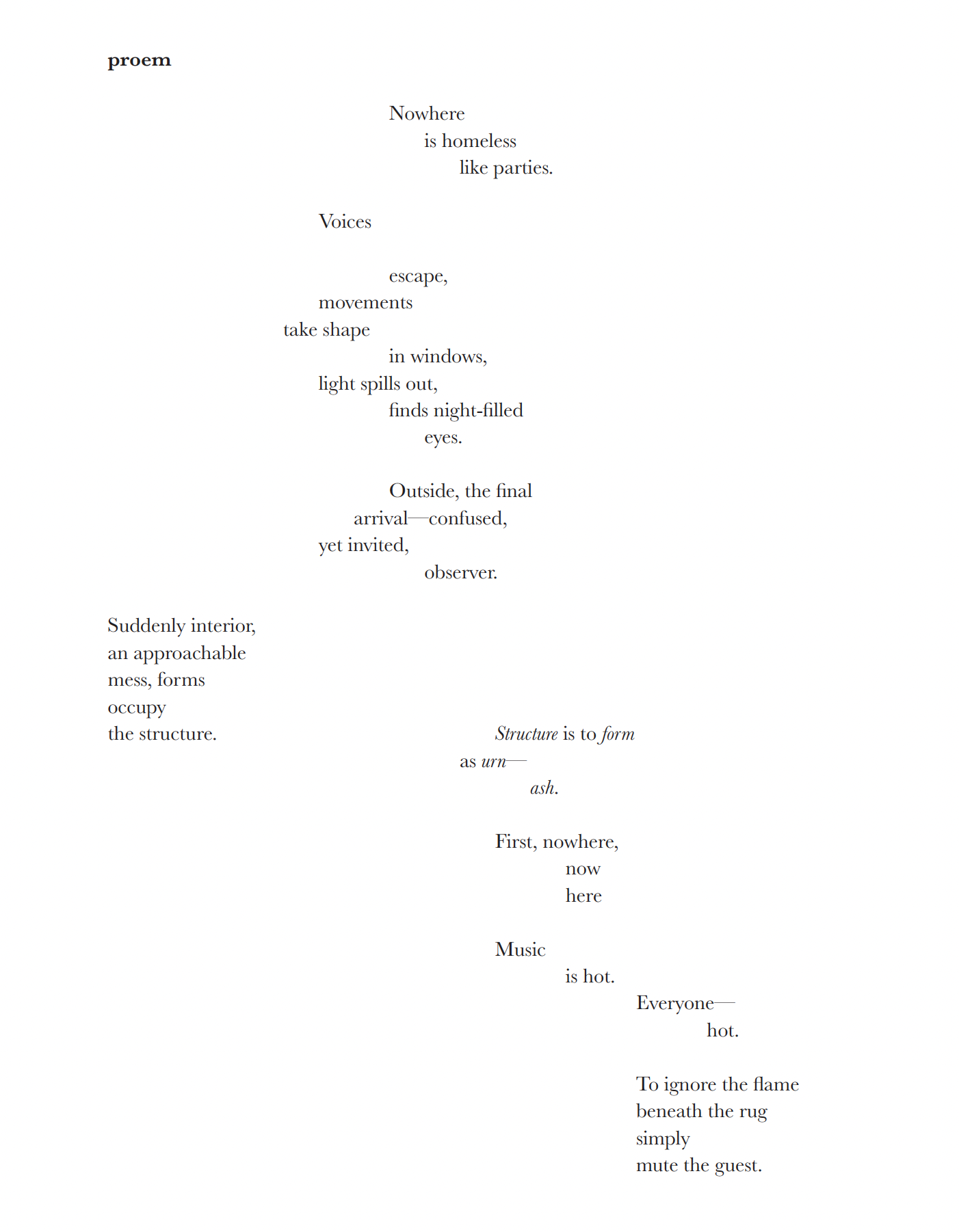
Read excerpts from within-group variance in Poetry magazine: “The Door of No Return has unlimited 5G data,”“Epistle: Antebellum Sexual Performance Therapy,” “Epistle: Come, Go Back, Child,” and “coriolis effect.”